How We Safely Pressure Wash Delicate Home Surfaces
Worried about pressure washing painted patios, epoxy garage floors, or small roof overhangs? Learn how we safely clean delicate surfaces without causing damage.
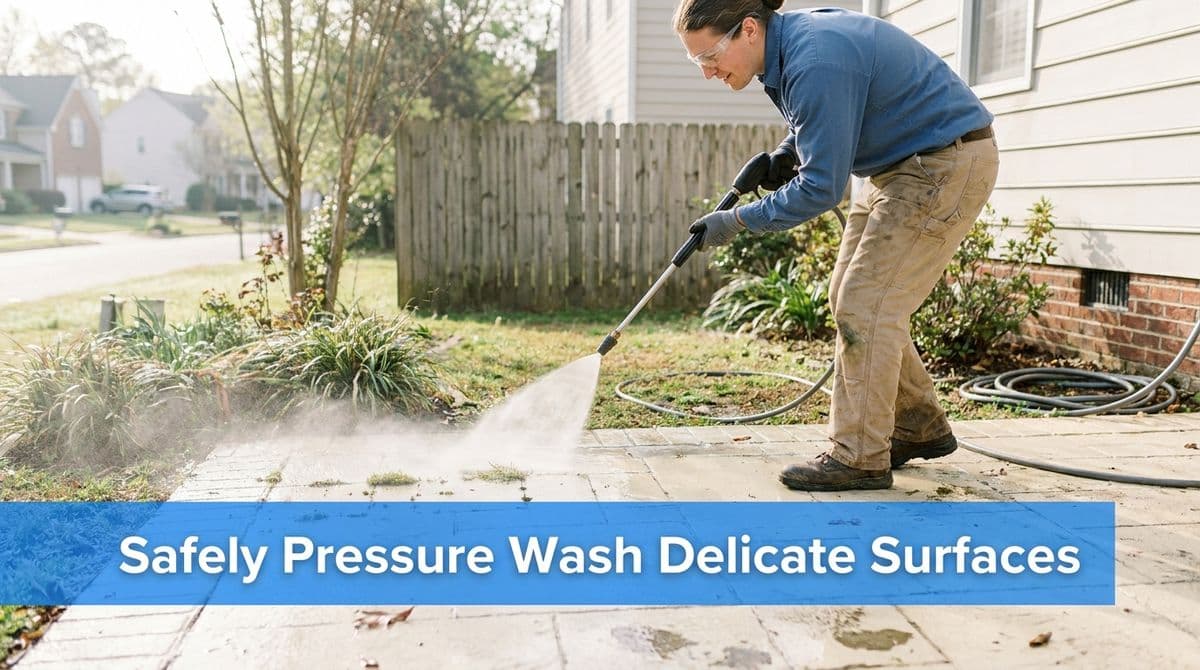
When a “Simple” Wash Involves Delicate Surfaces
We recently got a call from a customer — let’s call him Dave — who had seen one of our pressure washing specials online. He loved the idea of freshening up his porches but was nervous about a few delicate areas around his home.
Dave had three main concerns:
- A painted concrete patio where the paint was already a little weak
- An epoxy-coated garage floor he didn’t want dulled or peeled
- A small sloped roof overhang above the front door that was dusty and grimy
He asked us the question a lot of homeowners wonder: “Can you adjust the power so you don’t damage any of this?” We walked Dave through exactly how we handle delicate surfaces, and we’ll walk you through the same steps here.
Why “More Power” Isn’t Always Better
When people think pressure washing, they often picture blasting away dirt with the highest setting and a tight nozzle. On older paint, epoxy coatings, or small roof details, that’s a recipe for damage.
On Dave’s call, we explained that we almost never just crank the machine to max and start spraying. Instead, we control three key factors:
- Pressure (PSI) – We dial the machine down for sensitive surfaces.
- Distance – We stay 3–4 feet away to soften the impact.
- Nozzle type – We use wider fan tips, not needle-like jets, on delicate areas.
Sometimes we also change the entire approach and use soft washing, which relies more on cleaning solutions and low pressure than raw force. That’s often safer and more effective for fragile surfaces.
How We Safely Wash Painted Patios
Dave’s first worry was his painted patio. The paint wasn’t peeling badly yet, but he could tell it wasn’t bonded perfectly. He was afraid a hard blast would strip it right off.
Here’s how we handle a painted patio like his:
- Start with an inspection – If paint is already flaking everywhere, we’ll often recommend not pressure washing at all, or we’ll limit cleaning to specific areas. We’d rather walk away than be the ones who finish off a failing paint job.
- Dial down the pressure – We turn the machine down and step back. Working from 3–4 feet away gives a gentler rinse that still removes dust and surface grime.
- Use a wider fan tip – A 25–40° fan spreads the water out so there’s no “knife edge” cutting into the paint.
- Test a small spot first – We’ll pick an out-of-the-way corner, spray briefly, and see how the paint reacts before we commit to the entire patio.
In Dave’s case, the paint was worn but not failing, so a light wash with controlled pressure was a safe option. If you’re seeing large areas of flaking before you even touch it, that’s when we start talking more about repainting than washing.
Protecting Epoxy Garage Floors from Damage
Next, Dave asked about his epoxy garage floor. It had been installed right before he bought the home, and he wanted it cleaned without losing that glossy look or loosening the coating.
For epoxy garage floors, we explained our typical process:
- Clear the area – We ask whether the garage will be mostly empty or if we’ll be moving items. For Dave, bad back and all, it made more sense for our team to handle moving and putting everything back.
- Use moderate pressure – Epoxy is tougher than regular paint, but it’s still a coating. We avoid high-pressure needle tips and keep things at a controlled, moderate PSI.
- Choose the right cleaner – We use cleaners that break down oil, tire marks, and dirt without attacking the epoxy itself.
- Watch the edges and chips – If there are areas where the coating is already chipped or lifting, we’re extra cautious and may lower pressure further or avoid those spots.
Done correctly, a light to moderate pressure wash can refresh an epoxy floor without clouding the finish or peeling it up. The key is restraint and technique, not brute force.
Cleaning Small Roof Overhangs Safely
The last thing on Dave’s list was one many homeowners overlook: that small sloped roof over the front door. It was collecting dust and grime, and his lawn crew didn’t feel comfortable tackling it.
Even on a small overhang, we still treat it like a roof wash job, because the risks are similar:
- Material check – Is it shingle, tile, metal, or a coated flat surface? Each one responds differently to water pressure.
- Soft wash when possible – On many roof materials, we rely on low pressure and cleaning solutions that loosen algae, dirt, and stains, then rinse gently.
- Safe access – We think about ladder placement, footing, and run-off so water doesn’t shoot back toward the front door or electrical fixtures.
For a small overhang like Dave’s, a properly done soft wash is usually enough to make it look new again, without dislodging shingles or forcing water up under flashing.
Soft Washing vs. Pressure Washing: What’s the Difference?
On our call with Dave, we didn’t just talk about “turning the power down.” We also explained the difference between traditional pressure washing and soft washing, because that choice matters.
Pressure washing relies mostly on mechanical force — high-pressure water doing the scrubbing. It’s great for durable surfaces like plain concrete driveways and some masonry.
Soft washing uses low pressure combined with specialized cleaning solutions. The solutions do most of the work breaking down dirt, algae, and stains, while the water just rinses everything away. That makes soft washing ideal for:
- Most roof materials
- Painted or stained surfaces
- Older masonry and fragile trim details
For many delicate areas, we lean heavily toward soft washing or a hybrid approach rather than straight pressure washing.
DIY or Call a Pro? A Quick Checklist
If you’re looking at your own painted patio, epoxy floor, or roof overhang and wondering whether to DIY or bring in a pro, here’s a simple checklist we walked Dave through in spirit:
- Is the surface already peeling, flaking, or cracking?
If yes, be cautious. Washing may make the damage more visible. This is often a “talk to a pro” situation. - Do you know your machine’s PSI and how to adjust it?
If you only have a single, high-power setting and a narrow tip, avoid delicate surfaces. - Can you safely access the area?
Anything involving ladders, roof edges, or tight spaces is usually better handled by someone with the right safety gear and experience. - What happens if something goes wrong?
If a mistake means stripping paint, peeling epoxy, or causing a roof leak, it’s worth calling a pro.
Many homeowners, like Dave, are happy to rinse pool decking with a regular hose but prefer professional help for the more sensitive or hard-to-reach areas.
Before You Schedule: Photos Help Us Help You
One thing that really helped with Dave’s project was photos. We asked him to text pictures of:
- The painted patio
- The epoxy garage floor and how full the garage was
- The small roof overhang above the front door
With those images, we could give him realistic recommendations, choose the right methods, and set clear expectations on what would (and wouldn’t) be safe to clean with pressure or soft washing.
If you’re unsure how your surfaces will respond, sending photos ahead of time gives our team (or any reputable pressure washing company) a chance to protect your home and your finishes before anyone pulls a trigger.